T Sai Sanket Sharma
In the recent case of M.K. Ranjitsinh v. UOI, the Supreme Court recognised the right against the adverse effects of climate change within Article 21 of the Constitution. The court stressed the need to balance the protection of the Great Indian Bustard and promoting energy production through renewable sources. The question however is, can the court expand Article 21 to include such a right? If so, is the current approach appropriate?
Article 21: Implied Incorporation of Substantive Due Process
Article 21 merely mentions the right to ‘life’ and ‘personal liberty’ subject to the procedure established by law. However, post-emergency, the Supreme Court has recognised multiple unenumerated rights within Article 21 including the right to livelihood (Olga Tellis), the right to education (Unni Krishnan), and the right to health (Paschim Banga). Such an approach prima facie is contrary to the text of Article 21 given that the Constituent Assemble deliberately deleted ‘due process’ implying that the recognition of new rights within Article 21 is seemingly against the intention of the makers. Now ‘due process’ has two conceptions. First is procedural due process wherein the procedure followed needs to be fair and reasonable. The second is substantive due process with one aspect dealing with the requirement of the law itself being fair and the second aspect involving recognition of unenumerated rights. The phrase ‘due process’ finds mention in the Fifth and the Fourteenth Amendments to the U.S. Constitution which the U.S. Supreme Court has expounded to include multiple unenumerated rights like the right to a jury trial, the right to abortion and the right of parents to upbring children.[i] The author argues that although ‘due process’ is absent from the Indian Constitution, it has been impliedly incorporated by the Supreme Court which can be justified to a certain extent. In this regard, an analysis of landmark Supreme Court cases on the same is pertinent.
In A.K. Gopalan v. State of Madras, though Justice Mukherjea defined personal liberty restrictively as the antithesis of physical restraint or coercion, Justice S.R. Das defined personal liberty as a compendious term comprising multiple rights and Justice Kania included the right to sleep, work and eat within Article 21. However, concerning ‘procedure established by law,’ the majority concluded that it would be against the intent of the makers to introduce the elusive criteria of due process in the Constitution as it was specifically excluded. This changed in Kharak Singh v. State of U.P. wherein the majority held that personal liberty was a compendious term that included a variety of rights than those dealt within Article 19(1). Justice Subba Rao held in his dissent that personal liberty meant freedom from direct and indirect restrictions on one person. The court in Satwant Singh v. State of Punjab went further, and Justice Subba Rao concluded that liberty in our constitution was as comprehensive as liberty used in the Fifth and Fourteenth Amendments. This expansionary trend reached its zenith in Maneka Gandhi v. UOI wherein Justice Bhagwati held that personal liberty in Article 21 was of the widest amplitude and included the dignity of the individual. Further, Maneka recognised the unenumerated right to travel abroad as part of Article 21. Post Maneka, the Supreme Court has gone on to recognise multiple socio-economic rights within Article 21 though the text itself does not mention so. However, how can such an implied incorporation of due process be justified?
Justification for Substantive Due Process
Intention of the Framers
The first justification can be an originalist interpretation. Initially, the Sub-Committee on Fundamental Rights had drafted Clause 12 resembling the Fourteenth Amendment and included ‘due process of law’ which was passed unanimously by the Constituent Assembly in 1947. Consequently, the Drafting Committee was set up to give effect to the decisions of the assembly and prepare a draft of the Constitution. In the Drafting Committee, B.N. Rau during his visit to the U.S. was influenced by Justice Frankfurter of the U.S. Supreme Court to avoid the inclusion of ‘due process’ given the fear of the ‘Lochner Era’ in the U.S. wherein multiple legislations pertaining to economic and social welfare were struck down under the guise of ‘due process.’ Interestingly, the Drafting Committee deleted ‘due process.’ How did this change come about is however not clear. Of the seven members of the committee, based on the minutes of the relevant meeting, the views of N.M. Rau, K.M. Munshi and D.P. Khaitan are unknown. Concerning Ambedkar, he was indecisive given that he understood the possibility of a draconian government but had little faith in entrusting judges with immense power given their biases. How can then B.N. Rau himself have changed the wording?
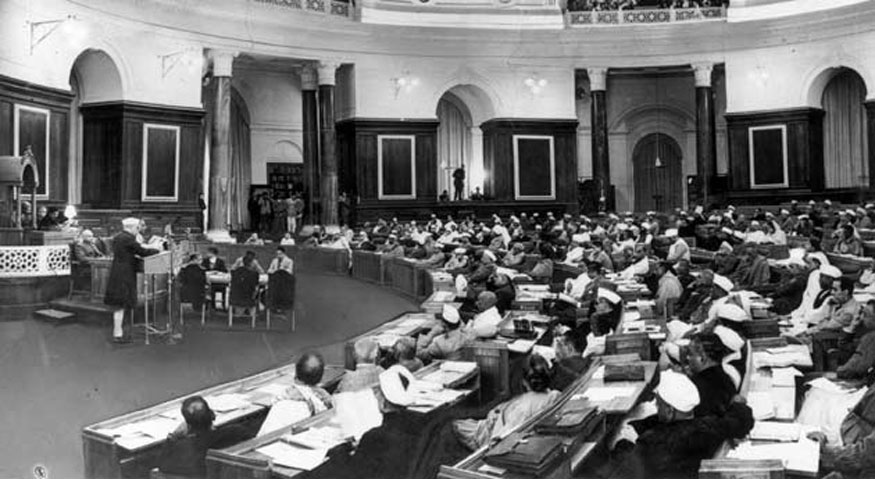
Further, the introduction of the new draft without ‘due process’ created an uproar in the Constituent Assembly. B.N. Rau justified the new clause contending that the same was inspired by the Japanese Constitution. Mahboob Baig however highlighted that the Japanese Constitution had not altogether abandoned due process since it provided due process rights like the right to access courts and the right against torture. Additionally, pertinent to note is that Ambedkar introduced the current Article 22 in response to the heated debate on ‘due process’ as atonement and himself was dissatisfied with the wording of Article 21. Seen in this light, given that the Constituent Assembly has initially adopted ‘due process’ unanimously, the unclear nature of the discussion of the Drafting Committee and the impending deadline to finish the Constitution, it can be contended that the original intention of the framers was to include some form of a due process clause.[ii]
DPSP and Fundamental Rights: Harmonious Interpretation
The second justification for incorporating ‘due process’ can be the relation between DPSPs and Fundamental Rights. In M.K. Ranjitsinh as well, the court used Article 48A of the Constitution concerning the duty of the state to improve the environment while recognising the right against the adverse effects of climate change within Article 21. Initially, in the State of Madras v. Champakam, the Supreme Court prioritised DPSPs over Fundamental Rights in case of conflict. However, after Minerva Mills v. UOI and Kesavananda Bharati v. State of Kerala, the Supreme Court has repeatedly emphasised the harmony between the two with Justice Mathew in Kesavananda highlighting that Fundamental Rights are empty vessels which need to be filled such that they further the fulfilment of DPSPs. It is submitted that the above approach is correct.
Article 37 requires DPSP to be ‘fundamental’ in the governance of the country thus equating non-enforceability to non-cognisability is incorrect.[iii] Such an approach is also in line with the freedom movement of India wherein socio-economic rights have been placed at par with civil and political rights. Ambedkar pointed out that the right to free speech was irrelevant to a hungry person[iv] and similarly, Nehru emphasised ensuring real economic freedom for the people through minimum wages, suitable conditions at work and retirement benefits.[v] Further, though the idea of DPSP has been picked from the Irish Constitution, it is not a replica in the Indian Constitution. In addition to being ‘fundamental’ as opposed to ‘general guidance’ in the Irish Constitution, the Indian Constitution addresses the DPSPs to the state instead of narrowingly addressing it to the legislature as done in the Irish Constitution. This means that the judiciary is constitutionally under a duty to use DPSPs while interpreting Fundamental Rights.[vi]
Issues with the Current Approach
Though the current approach of the judiciary impliedly incorporating ‘due process’ can be justified, there are two major issues that remain unaddressed. Firstly, Article 21 is often linked to ‘life with dignity’ without any framework explaining what exactly dignity entails. Starting with Francis Coralie Mullin v. The Administrator, Union Territory of Delhi, the Supreme Court has failed to distinguish the meaning of ‘life’ and ‘personal liberty’ and has gone on to recognise multiple rights within Article 21 under the abstract concept of dignity. There is no hierarchy between the newly recognised rights and it is not clear for instance if the right to privacy is more important than the right to a clean environment. Such an approach leaves complete discretion to the judges and it essentially breaks down to the thinking of the judge as to which right should be protected and which not.[vii]
Secondly, any case concerning Article 21 invariably involves the invocation of the golden triangle of Articles 14, 19 and 21. In A.K. Gopalan, the majority held that Articles 19 and 21 occupy separate domains and there was no overlap between them. This mutual exclusivity was however rejected in R.C. Cooper v. UOI and building on the same, Maneka held that Articles 14, 19 and 21 are all linked and any law challenged under Article 21 will also have to pass the test under the other two but the common test laid down was the reasonableness test under Article 14. The problem is that Article 19 talks about ‘reasonable restrictions’ whereas Article 21 talks about ‘deprivation’, thus the test for both cannot be the same.[viii] Secondly, by integrating the three Articles, the court is stating that if Article 21 applies, Articles 14 and 19 automatically apply. This conclusion is erroneous because Article 14 is based on classification and Article 19 talks about freedoms.[ix]
Conclusion
In sum, while the implied inclusion of ‘due process’ within Article 21 can be justified constitutionally, the current approach lacks clarity. The lack of a clear framework for recognising new rights within Article 21 creates uncertainty and the conflation of Articles 14, 19, and 21 overlooks the content of each article and the different restrictions mentioned therein.
Endnotes:
[i] Erwin Chemerinsky, ‘Substantive Due Process’ (1999) 15 (4) Touro Law Review 1501 and David G. Barnum, ‘Article 21 and Policy Making Role of Courts in India: An American Perspective’ (1988) 30 (1) Journal of the Indian Law Institute 19.
[ii] Rohan J. Alva, Liberty After Freedom: A History of Article 21, Due Process and the Constitution of India (HarperCollins India, 2022).
[iii] Upendra Baxi, ‘Directive Principles and Sociology of Indian Law – A Reply to Dr. Jagat Narain’ (1969) 11 (3) Journal of the Indian Law Institute 245.
[iv] Gautam Bhatia, ‘Directive Principles of State Policy’ in Sujit Choudhry, Madhav Khosla and Pratap Bhanu Mehta (eds), Oxford Handbook of the Indian Constitution (OUP, 2016).
[v] Granville Austin, The Indian Constitution: Cornerstone of a Nation (Oxford University Press, 32nd edition, 2018).
[vi] Abhinav Chandrachud, ‘Due Process’ in Sujit Choudhry, Madhav Khosla and Pratap Bhanu Mehta (eds), Oxford Handbook of the Indian Constitution (OUP, 2016).
[vii] Anup Surendranath, ‘Life and Personal Liberty’ in Sujit Choudhry, Madhav Khosla and Pratap Bhanu Mehta (eds), Oxford Handbook of the Indian Constitution (OUP, 2016).
[viii] Sanjay Jain, V.D. Mahajan’s Constitutional Law of India (EBC, 8th edition, 2023).
[ix] P.K. Tripathi, ‘The Fiasco of Overruling A.K. Gopalan’ (1990) All India Reporter.
The Author is a third year student of National Law School of India University Bangalore
Image Credits: Getty Images
 Constitutional Law Society
Leave a comment