The article aims to address the issue of Transgender reservation. The Indian Constitution mandates affirmative measures for safeguarding the interests of vulnerable communities and preventing exploitation. Nevertheless, the author is of the opinion that legislative efforts regarding reservations for the transgender community have been fragmented and incoherent. The author suggests that it is now imperative to grant horizontal reservations for the transgender community. Furthermore, the author stresses the requirement for distinct reservations due to the unique challenges faced by the transgender community, advocating for horizontal reservation, that is flexible and self-adjusting. Finally, the article calls for acknowledging and upholding the legitimate claims of the transgender community to foster a fairer and more equitable society.
Democracy at Crossroads: Examining the Controversial Practice of Voice Votes in the Indian Parliament
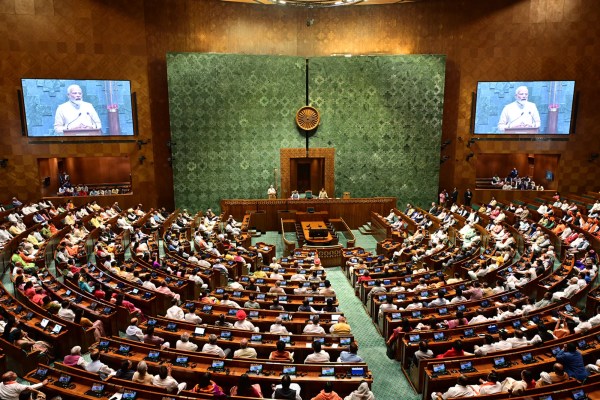
The constitutionality of utilizing voice votes in parliamentary sessions amidst protests raises intricate questions at the intersection of procedural efficiency and democratic governance. Proponents assert that voice votes offer a swift mechanism for decision-making, crucial in the fluid dynamics of legislative proceedings, particularly during protests. They emphasize the necessity of adapting to challenging circumstances to maintain the functionality of the legislative body. To ascertain the constitutionality of voice votes amid protests, a nuanced examination of constitutional principles is imperative. In essence, resolving this issue requires a judicious weighing of competing constitutional values, striving to establish a parliamentary system that not only remains efficient but also upholds democratic ideals, even in the throes of dissent. It beckons a careful calibration to ensure that the mechanisms employed are both expedient and respectful of the democratic norms enshrined in the Constitution.
From Bench to Society: Assessing the Impact of Judicial Ideology
The article explores the concept of judicial ideology and the three distinct methods employed to measure it, emphasizing the significance of addressing this issue in contemporary legal discourse. Judicial ideology, defined as the set of beliefs and principles guiding judges' decision- making, is a critical factor influencing legal interpretations and decisions. While proxy measures, behavioral assessment, and the transplanting of ideology measures offer ways to gauge judicial ideology, their applicability and limitations vary across different legal systems. As judicial ideologies evolve, the integrity of an independent judiciary is at stake, prompting a call for acknowledgment and definition of these ideologies to ensure fairness and equal protection of rights within the justice system. Ultimately, a comprehensive understanding of judicial ideology is essential to create a legal system that serves all members of society.
Navigating the โNeutralityโ Quagmire: Unpacking Subhash Desai v. Principal Secretary and the Nabam Rebia Conundrumย ย
The recent judgment of the Supreme Court in Subhash Desai v. Principal Secretary, Governor of Maharashtra & Ors has lately been in news due to its upcoming hearing before a 7-judge-bench. Subhash was set in the context of the political controversy regarding the intra-party dissent and subsequent alleged defections that took place within the Shiv Sena Legislative Party in Maharashtra. This article critically analyses the position propounded in Subhash regarding the reference of Nabam Rebia v. Deputy Speaker, Arunachal Pradesh Legislative Assembly to a larger bench. Ultimately, this article argues that there are several inconsistencies present in the application of the reasons specified for referring Nabam to a larger bench. Further, it contends that the interim measure proposed in Subhash is unconstitutional in nature and thus, should be set aside.
Unconstitutionality of Section 15 of the Hindu Succession Act, 1956- Discrimination in the Order of Inheritance
In this Legislation Review, the Author has explained how Section 15 of the Hindu Succession Act violates Articles 14 and 15 of the Indian Constitution, rendering it unconstitutional. This has been done in light of a recent petition to the Supreme Court. While the Act claims that the order of inheritance is based on the proximity of the relationship, Section 15 does not adhere to this principle. This also goes against the principles of justice, equity, and good conscience. Thus a new scheme for Section 15 has been proposed.
The Places of Worship Act, 1991: An Enquiry into Constitutionality
The Places of Worship Act was intended to cease communal conflicts over history but it has failed to prevent conflicts such as the Gyanvapi Row. A part of this failure is attributable to the legislatureโs omission to succinctly identify the existence of complex religious structures and conflicting historical experiences. This article examines the constitutionality of the Actโs provisions against the backdrop of history and provides an analysis of the ambiguity in the Act that needs rectification to ensure the true realization of justice.
Unveiling the expanded scope of “State”: When private entities take public roles
Article 12 of the Indian Constitution defines โStateโ. In the initial years of Indiaโs independence, the notion of โstateโ was defined quite narrowly by the Supreme Court of India. It was only later that the Courts took a liberal view while interpreting โStateโ. Due to privatisation, there are more private organisations and corporations than ever before. It is essential that they fall under the definition of โStateโ in order to enforce fundamental rights against them and devolve liability in a way that escorts the devolvement of power and authority from traditional bases like governmental organs to private players. This article examines the evolving interpretation of the term โStateโ in the Indian Constitution in light of increasing privatization. It emphasizes the importance of safeguarding fundamental rights and explains how courts have expanded the definition of โStateโ to hold private entities accountable.
Re-evaluating the U.S. Judgement on Affirmative Action: A need for reconsideration?
The recent US Supreme Court verdict asserting race-based reservation unconstitutional has ignited widespread criticism globally. The article delves into analyzing the implications of the judgment on American society and its education system. Drawing parallels with the trend of affirmative action in India, the authors suggest that the US Supreme Court should draw a comparison between the discrimination faced by untouchables and blacks in India and the US respectively. Hence, the authors advocate for reconsidering the recent judgment, arguing that the previous system of affirmative action aligns better with the principles of justice and equality.
The DPDP Act: Need for an Objective Legislation instead of a Vague Notion of ‘Balancing Rights and Public Interest’
The authors, in this article, delve into the speculations about the DPDP Act and analyze the areas of concern to the depth of interpreting expressions used in the statutesย with respect to Privacy, Right to Information and its balance National Security. They also discusses possible solutions by drawing cues from other legislations.
Federating Rights: Democracy, Federalism and Governance
The article is premised on the recent GNCTD Act and its impact on federalism. It takes a detour from the popular discourse and explores federalism through the lens of fundamental rights. It argues that the right to vote and self-governance can be considered fundamental rights under Article 19(1)(a) of the Indian Constitution.
Unmasking Dark Patterns: Preserving Cognitive Liberty and Safeguarding Informational Privacy
The author, while recognizing the increased functioning of dark patterns to allude consumers, seeks to delve into the psychological intricacies associated with those and the data protection implications that arise from the employment of such designs. The article also provides an insight into how the Personal Data Protection Bill, 2023 can protect the data privacy rights of users whose choices are unethically manipulated.
(Part 2) – Transfers of High Court Judges: Testing the viability of planting the seed of transparency in the plant that is opaque procedure
This is the second part out of two parts of an article dealing with the transfer of judges within the Indian judiciary. The second part will explore the validity and viability of the two mechanisms that can instill transparency- suo moto disclosure of reasons by the collegium and obtaining the disclosure of reasons through the Right to Information Act, 2005. It explains how both of these mechanisms are unviable, in turn concluding that the expectation of transparency would not be able to translate into reality.