Judicial activism can be broadly perceived as judicial interpretation and review of statutes or other state action. Judicial legislation, on the other hand, lays down new in case of a legislative insufficiency. The relation and conflict between the two can be studied in the context of the call for a liberal interpretation of the Special Marriage Act, applicability of judicial review in money bills or even in the electoral practice of freebies and whether it is akin to a corrupt practice.
Growth in Technology and Misinformation: A Rising Concern to Electoral Integrity in India
This article analyses the proliferation of misinformation in light of growth in technology and its implications on the erosion of the democratic process. It highlights the constitutional aspects involved and the vacuum in the current regulatory framework. The article proposes reforms to counter the challenges posed by the digital era.
Freebies In Electoral Democracies: A Necessary Change Withheld by Major Challenges?
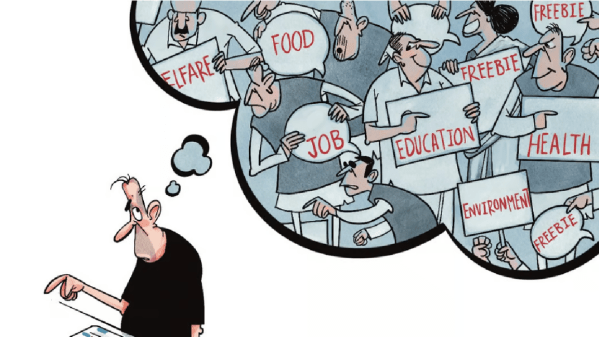
For a while now, an eternal debate has existed on the issue of freebies and welfarism. Their nature is so close that it becomes impossible to differentiate between the two and draw a clear line of demarcation. While welfare policies are deemed to be irreplaceable and for the goodwill of society, freebies are understood to be vicious and a method of manipulation used to win political support at the expense of fiscal prudence. Freebies or welfare policies as may be referred to by both sides of the argument undoubtedly have political, economic and social implications. The question that then arises is whether their benefits exerted on society are sufficient to overcome the looming dangers that hide behind the veil of welfare. As this discussion reaches the Supreme Court, this blog highlights a few challenges that lie ahead.
Battling Digital Disinformation: The Imperative of Fact-Checking in a Participatory Democracy (Part II)
Disinformation and misinformation has been earmarked as aย โglobal riskโ,ย causing โinformation pollutionโย that adversely impacts decision making and socio-economic and politicalย stability.ย Part โ II intends to explore the evolving interpretation of the theory of โmarketplace of ideasโ under Article 19(1)(a) to point out that disinformation and misinformation on government affairs distorts the foundation of democracy, i.e., truth. Accordingly, the article emphasises on the need to fact-check in order to ensure plurality of views based on factually true information, since discourse based on false information makes the citizen's participation in democracy a futile exercise.
Battling Digital Disinformation: The Imperative of Fact-Checking in a Participatory Democracy (Part I)
Disinformation and misinformation has been earmarked as aย โglobal riskโ,ย causing โinformation pollutionโย that adversely impacts decision making and socio-economic and politicalย stability. In light of this, Part โ I of this Article aims to expplain the imperative and constitutionality of the Fact-Check Unit (FCU) underย Rule 3(1)(b)(v) of the IT Rules, 2021, through a comparativeย study.ย
Bizarre Bail: The Rise of Unconventional Conditions in Indian Jurisprudence
This article attempts to explore the growing trend of unconventional bail conditions in Indian courts, focusing on two key cases: Frank Vitus v. Narcotics Control Bureau and Faizal v. State of Madhya Pradesh. It analyzes the latter on the basis of principles of fairness, proportionality, and justice established in the former, urging the judiciary to re-evaluate its approach.
Speakerโs Inaction No Longer Immune: Telangana High Courtโs Purposive Lens on Judicial Review Over Speakerโs Delay in Anti-Defection Pleas
In its recent verdict, the Telangana High Court directed the Telangana Legislative assembly speaker to decide the disqualification petitions pending against the defecting Bharatiya Rashtra Samiti (BRS) MLAs into the ruling Congress Party within four weeks. The judgment, Kuna Pandu Vivekanand v. State of Telangana, pronounced by a Single-judge bench of Honโble Justice Vijaysen Reddy underscored that a complete abdication of judicial review concerning the inaction of speaker, as a constitutional functionary, is an anathema and repugnant to the greater democratic values. This article analyses this judgement.
Horizontal Application of Privacy Rights: A Constiutional Tort Framework
This post discusses the critical role of privacy rights in todayโs digital landscape, emphasizing enforcement challenges due to privacyโs dual recognition as a fundamental and common law right. Drawing on the Supreme Courtโs recent Kaushal Kishor ruling, it advocates for a constitutional tort framework that allows horizontal application of privacy rights within a unified legal structure.
Laissez-Faire Meets Localism: Domicile Reservations in Karnataka’s Private Sector
The Karnataka government recently introduced a bill mandating substantial reservations for domiciled residents in private-sector jobs, which was swiftly put on hold amid widespread criticism. This blog explores the complex constitutional, legal, and economic ramifications of such domicile-based reservations. By examining judicial precedents and constitutional provisions, the Author highlights the tension between promoting local employment and upholding the principles of meritocracy and laissez-faire that govern private enterprises. Drawing comparisons with similar initiatives in Haryana and Andhra Pradesh, which faced judicial pushback, this analysis underscores the potential risks to Karnataka's economic landscape if the bill were to be implemented. The Author argues that while the intention to support local employment is commendable, it must be balanced with the need to maintain a business-friendly environment and respect for constitutional guarantees of free movement and equality across states.
FRMB Act 2003: A Source of Fiscal Anxiety, not Prudence
Here, the Author examines the FRBM framework post 2009. It starts with a discussion of the evolution of the Act. It then discusses the logic of fiscal federalism adopted in the Indian constitution - along with its statutory contortions. It problematises the erosion of state fiscal autonomy in the context of the FRBM Act. Finally the piece speaks of the feasibility of balancing fiscal prudence with sub-national fiscal autonomy within the constitutional framework.
Balancing Rights and Justice: The Constitutionality of Psycho-Analysis Tests
This article delves into the constitutionality of psycho-analysis tests within criminal investigations in India. It critically examines the conflict between these investigative tools and the fundamental rights against self-incrimination (Article 20(3)) and the right to privacy (Article 21) under the Indian Constitution. The author argues that justice should be served while balancing state interests with individualย freedoms.
Deliberation as a Constitutional Requirement: Examining the Judicial Review of Legislative Process in India (Part II)
This article, in two parts examines the constitutional implications of non-deliberative legislative processes in India, focusing on recent controversial laws like the electoral bonds scheme. It argues that deliberation is integral to parliamentary democracy and proposes that courts should be empowered to review legislative processes on grounds of non-deliberativeness to uphold constitutional values and improve democratic outcomes.