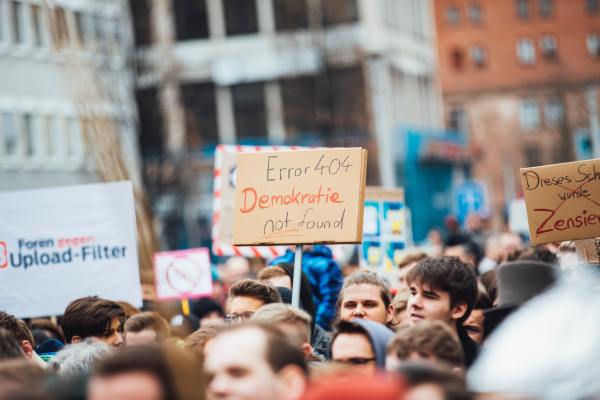
Meghna Bhaskar Introduction Dissent has been iterated by Justice D.Y. Chandrachud in the Bhima Koregaon case as the safety valve of a democracy. It is asserted by left-leaning civil liberty activists that the curb on freedom of speech and expression has become an institutional mechanism to police the opinions and curb lively debate and a... Continue Reading →
RTI Amendment Bill: An Attempt to Curtail the Right
Juned Akhter This is for the second time in a span of two years when the Government has endeavoured to pass legislation pertaining to Right to Information Act, 2005 which also comes under the scope of Freedom of Speech and Expression.[i] In 1986, the Supreme Court in the famous case of Mr. Kunwar v.... Continue Reading →
Drops of Federalism
Anmol Mittal A spate of floods in a self-declared water-stressed country has shed light on the governance of water ‘resources’ in India. The assumption of control over Water by the Union is an encouraging sign. India, already a self-declared water-stressed country, faces an immense challenge.[1] Behaviorally, there is not too much evidence to suggest that... Continue Reading →
Can Reasonable Expectation of Privacy be a ‘Buffer’ Legislation for India
Anjani Kumar Srivastava and Ashit Kumar Srivastava On 24th August 2017, the Indian Supreme Court shredded away the lethargic cloak of original(ism) and embraced privacy with both its hand. However, the functionality of privacy demands more than just an acceptance; there has to be an intricate surgery to imbibe criteria of applications; one such application... Continue Reading →
Analyzing the Constitutionality of S 33 (7), Representation of People Act, 1951: Proposing Remedies
Deeksha Sharma Recent trends in Indian electoral politics have seen the emergence of an increasing number of candidates contesting from more than one constituency. This article highlights how the apex court of India, had already erroneously upheld the Constitutionality of this provision and also suggests some solutions for the same. This system of parliamentary elections... Continue Reading →
Continuing Choices: Can Simultaneous Elections be A Credible Solution?
Priyanka Rai In a parliamentary democracy like India, Good Governance is the prime responsibility but is this actually a possibility given the continued election mode our country is always in, is a question which needs assessment. The citizens, the political parties and the Election Commission are the key stakeholders in the process of decision-making and... Continue Reading →
Reduced to Puppets? The Enchantment of Anti-Defection
Tanmay Batham Tenth Schedule: Brief Overview Webster defines Defection as a conscious abandonment of allegiance or duty (i) while MacMillan defines it simply as an act of leaving one’s country or political party to go to another one. (ii) This understanding of the word indicates that there is a connotation of hostility attached to the... Continue Reading →
The Mavalankar Rule: The Selection of the Leader of Opposition
Sarvotham M Naik In the light of recent election results where the country has witnessed the formation of the government by a single political party with a sweeping majority, a debate has arisen as in who shall become the leader of opposition. The requirement of a minimum number of members for the recognition of a... Continue Reading →
Back Up Plans at The Cost of Electorate
Vrinda Aggarwal On 7th February, 2018, Ashwini Kumar Upadhyay filed a writ petition in the Supreme Court of India against the Election Commission (EC) and the State, challenging the validity of S. 33(7)(a) of the Representation of People’s Act, 1951 (Act), according to which “person shall not be nominated as a candidate for election— in... Continue Reading →
Need to Revisit the Right to Vote of Migrant Labourers
Advik Rijul Jha According to recent reports, approximately 60 million men and women, crisscrossing the country as migrant workers, were unable to cast their vote because their voting rights are restricted to their villages, where they have to be present to be able to vote.[i] This gives rise to a concern about the political voice-lessness of... Continue Reading →
BJP’s Resounding Victory: What It Means
Dr. Manisha Madhava Introduction The electoral verdict of 2019 confirmed the dominance of the Bharatiya Janata Party (BJP). BJP’s victory is the most resounding verdict of any political party in recent times. The NDA won 353 out of 543 seats in the Lok Sabha and BJP alone won 293 seats, of the 437 seats, 11 more... Continue Reading →
NOTA in India: A Real Choice?
Paras Ahuja Introduction NOTA or “None of the Above” option is a window provided for those voters, who would prefer to not vote for any of the candidates contesting election in their constituencies, expressing their dissent and disapproval. The use of this democratic tool of protest by the Indian citizenry has been on the rise,... Continue Reading →