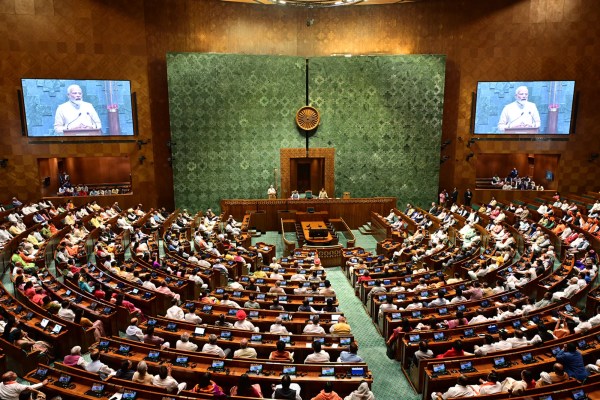
The constitutionality of utilizing voice votes in parliamentary sessions amidst protests raises intricate questions at the intersection of procedural efficiency and democratic governance. Proponents assert that voice votes offer a swift mechanism for decision-making, crucial in the fluid dynamics of legislative proceedings, particularly during protests. They emphasize the necessity of adapting to challenging circumstances to maintain the functionality of the legislative body. To ascertain the constitutionality of voice votes amid protests, a nuanced examination of constitutional principles is imperative. In essence, resolving this issue requires a judicious weighing of competing constitutional values, striving to establish a parliamentary system that not only remains efficient but also upholds democratic ideals, even in the throes of dissent. It beckons a careful calibration to ensure that the mechanisms employed are both expedient and respectful of the democratic norms enshrined in the Constitution.
From Bench to Society: Assessing the Impact of Judicial Ideology
The article explores the concept of judicial ideology and the three distinct methods employed to measure it, emphasizing the significance of addressing this issue in contemporary legal discourse. Judicial ideology, defined as the set of beliefs and principles guiding judges' decision- making, is a critical factor influencing legal interpretations and decisions. While proxy measures, behavioral assessment, and the transplanting of ideology measures offer ways to gauge judicial ideology, their applicability and limitations vary across different legal systems. As judicial ideologies evolve, the integrity of an independent judiciary is at stake, prompting a call for acknowledgment and definition of these ideologies to ensure fairness and equal protection of rights within the justice system. Ultimately, a comprehensive understanding of judicial ideology is essential to create a legal system that serves all members of society.
Navigating the ‘Neutrality’ Quagmire: Unpacking Subhash Desai v. Principal Secretary and the Nabam Rebia Conundrum
The recent judgment of the Supreme Court in Subhash Desai v. Principal Secretary, Governor of Maharashtra & Ors has lately been in news due to its upcoming hearing before a 7-judge-bench. Subhash was set in the context of the political controversy regarding the intra-party dissent and subsequent alleged defections that took place within the Shiv Sena Legislative Party in Maharashtra. This article critically analyses the position propounded in Subhash regarding the reference of Nabam Rebia v. Deputy Speaker, Arunachal Pradesh Legislative Assembly to a larger bench. Ultimately, this article argues that there are several inconsistencies present in the application of the reasons specified for referring Nabam to a larger bench. Further, it contends that the interim measure proposed in Subhash is unconstitutional in nature and thus, should be set aside.
Unconstitutionality of Section 15 of the Hindu Succession Act, 1956- Discrimination in the Order of Inheritance
In this Legislation Review, the Author has explained how Section 15 of the Hindu Succession Act violates Articles 14 and 15 of the Indian Constitution, rendering it unconstitutional. This has been done in light of a recent petition to the Supreme Court. While the Act claims that the order of inheritance is based on the proximity of the relationship, Section 15 does not adhere to this principle. This also goes against the principles of justice, equity, and good conscience. Thus a new scheme for Section 15 has been proposed.
Unveiling the expanded scope of “State”: When private entities take public roles
Article 12 of the Indian Constitution defines “State”. In the initial years of India’s independence, the notion of “state” was defined quite narrowly by the Supreme Court of India. It was only later that the Courts took a liberal view while interpreting “State”. Due to privatisation, there are more private organisations and corporations than ever before. It is essential that they fall under the definition of “State” in order to enforce fundamental rights against them and devolve liability in a way that escorts the devolvement of power and authority from traditional bases like governmental organs to private players. This article examines the evolving interpretation of the term “State” in the Indian Constitution in light of increasing privatization. It emphasizes the importance of safeguarding fundamental rights and explains how courts have expanded the definition of “State” to hold private entities accountable.
Re-evaluating the U.S. Judgement on Affirmative Action: A need for reconsideration?
The recent US Supreme Court verdict asserting race-based reservation unconstitutional has ignited widespread criticism globally. The article delves into analyzing the implications of the judgment on American society and its education system. Drawing parallels with the trend of affirmative action in India, the authors suggest that the US Supreme Court should draw a comparison between the discrimination faced by untouchables and blacks in India and the US respectively. Hence, the authors advocate for reconsidering the recent judgment, arguing that the previous system of affirmative action aligns better with the principles of justice and equality.
Demonetization Verdict and its Deep Overtones: It’s the time to Prioritize?
The authors, in this article, discuss the Supreme Court's growing backlog of cases. Through the example of the demonetization verdict, the authors highlight the need for prioritizing substantial legal and constitutional matters. They have also discussed recent reforms made to the case listing system and the need for broad-based reforms to address the issue of backlog.
Progressive Constitutions
The author in the piece argues that progressive constitutions should keep pace with societal changes, avoid abuse, and ensure citizen participation. The discussion is in light of the recent events in Chile and India show erosion of constitutional principles, compromising democratic institutions and principles of federalism.
Critiquing The Existing Literature By Analyzing The ‘Surname’ Debate
The author in this article highlights the Hon'ble Apex Court's interpretation of the Hindu Minority and Guardianship Act, 1956 and the Hindu Adoption and Maintenance Act, 1956, with regard to the biological mother’s right to decide the child's surname. The article also addresses the question of whose surname will prevail in light of a judgment of Italian Constitutional Court and critiques existing pieces on the Akella verdict.
On Preventive Detention and the Need for a Compensatory Framework in Constitutional Tort Cases.
The author in the article comments on a recent judgement of the Madras High Court (Sunitha v. Additional Chief Secretary) which has highlighted the callousness with which the state misuses preventive detention provisions in the law. Further, the article analyses the compensatory jurisprudence of the Court in constitutional tort cases and the need to develop a legislative framework for the same.
Reform, That You May Preserve
The author in this piece discusses the ongoing conflict over the method of judicial appointments in India. He critiques judicial primacy in judicial appointments in light of the dissent of Justice Chelameswar in the NJAC case. The author suggested a new model based on the United Kingdom's model for appointing judges in India.
The Standard of Judicial Review in Religious Rights Adjudication
The author in this article discussed the interpretation of the Essential Religious Practices Test over the years. He highlights the need to do away with the Essential Religious Practices Test. The author has also proposed an alternative approach to view the essentiality of a religious practice.