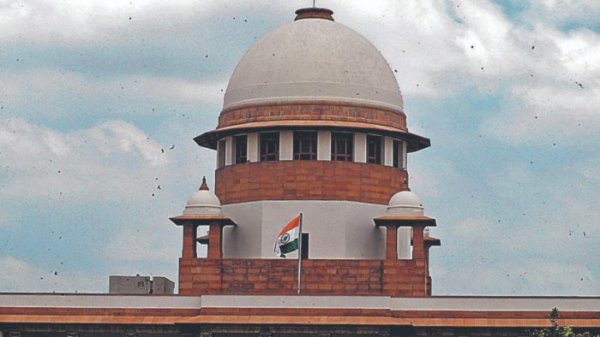
Beyond the Speaker’s Discretion: Expanding Judicial Review in Disqualifications

This article argues for expanding judicial review of political defection cases in India, where speakers’ partisan decisions have undermined the Tenth Schedule’s democratic purpose. It contends that substantive judicial intervention is constitutionally necessary to safeguard democracy, despite challenges to the separation of powers doctrine.

Pardon the interruption: Silencing of judicial review by §472(7) of BNSS, 2023 [Part II]

This two-part essay examines Section 472(7) of the Bhartiya Nagarik Suraksha Sanhita, 2023, which seems to bar judicial review of constitutional pardon powers of the executive. It highlights how the provision undermines constitutional principles, including separation of powers, rule of law, and fundamental rights. The first part discusses the current, pre-BNSS, judicial and constitutional framework, emphasizing the need for a limited judicial review to prevent executive arbitrariness. The second part critiques the new provision and proposes a harmonized interpretation to preserve judicial oversight and safeguard democratic principles against executive overreach.

Pardon The Interruption: Silencing Of Judicial Review By §472(7) Of BNSS, 2023 [Part I]

This two-part essay examines Section 472(7) of the Bhartiya Nagarik Suraksha Sanhita, 2023, which seems to bar judicial review of constitutional pardon powers of the executive. It highlights how the provision undermines constitutional principles, including separation of powers, rule of law, and fundamental rights. The first part discusses the current, pre-BNSS, judicial and constitutional framework, emphasizing the need for a limited judicial review to prevent executive arbitrariness. The second part critiques the new provision and proposes a harmonized interpretation to preserve judicial oversight and safeguard democratic principles against executive overreach.

Justice at a Crossroads: The Promise & Peril of Judicial Privatization in India

Imagine a justice system where the snake of briskness in business is forever strolling on the crosshairs of the crocodile of justice's sobriety. That is the imagination invoked with the privatization of justice: the makings of a once-in-a-lifetime overhaul of the justice administration system. The question would then be whether, on grounds of judicial inefficiency, such a bold step would offer the key to a resolution or would only serve to open the box of Pandora anew. At the frontier of corporate innovation and justice, this essay analyses India's judicial privatization—looking at how, at one level, privatization holds out prospects for a sea change in efficiency and creativity, and at another level, there are the critical risks of corruption and inequality—along with present global insights and safeguards for this transformative shift.

On the line between judicial activism and judicial legislation

Judicial activism can be broadly perceived as judicial interpretation and review of statutes or other state action. Judicial legislation, on the other hand, lays down new in case of a legislative insufficiency. The relation and conflict between the two can be studied in the context of the call for a liberal interpretation of the Special Marriage Act, applicability of judicial review in money bills or even in the electoral practice of freebies and whether it is akin to a corrupt practice.

Battling Digital Disinformation: The Imperative of Fact-Checking in a Participatory Democracy (Part I)

Disinformation and misinformation has been earmarked as a ‘global risk’, causing ‘information pollution’ that adversely impacts decision making and socio-economic and political stability. In light of this, Part – I of this Article aims to expplain the imperative and constitutionality of the Fact-Check Unit (FCU) under Rule 3(1)(b)(v) of the IT Rules, 2021, through a comparative study. 

Speaker’s Inaction No Longer Immune: Telangana High Court’s Purposive Lens on Judicial Review Over Speaker’s Delay in Anti-Defection Pleas

In its recent verdict, the Telangana High Court directed the Telangana Legislative assembly speaker to decide the disqualification petitions pending against the defecting Bharatiya Rashtra Samiti (BRS) MLAs into the ruling Congress Party within four weeks. The judgment, Kuna Pandu Vivekanand v. State of Telangana, pronounced by a Single-judge bench of Hon’ble Justice Vijaysen Reddy underscored that a complete abdication of judicial review concerning the inaction of speaker, as a constitutional functionary, is an anathema and repugnant to the greater democratic values. This article analyses this judgement.

Horizontal Application of Privacy Rights: A Constiutional Tort Framework

This post discusses the critical role of privacy rights in today’s digital landscape, emphasizing enforcement challenges due to privacy’s dual recognition as a fundamental and common law right. Drawing on the Supreme Court’s recent Kaushal Kishor ruling, it advocates for a constitutional tort framework that allows horizontal application of privacy rights within a unified legal structure.

Balancing Rights and Justice: The Constitutionality of Psycho-Analysis Tests

This article delves into the constitutionality of psycho-analysis tests within criminal investigations in India. It critically examines the conflict between these investigative tools and the fundamental rights against self-incrimination (Article 20(3)) and the right to privacy (Article 21) under the Indian Constitution. The author argues that justice should be served while balancing state interests with individual freedoms.

The Delhi Water Crisis Case: Activism or Overreach?

The Supreme Court gave a landmark decision in the Delhi water crisis case. The Author attempts to decode certain aspects of the judgement, focusing on its directive to release Yamuna river water amid acute scarcity in the capital. It examines the legal intricacies surrounding the Court's jurisdiction, the implications for water management, and the dynamics of inter-state water disputes. Central to the discussion is the debate over whether the Court's intervention signifies judicial activism or exceeds its constitutional mandate. By analyzing these complexities, the Article underscores the judiciary's role in ensuring equitable outcomes and protecting fundamental rights in critical public interest matters.

Up ↑