Judicial Appointments in a Limbo: The Executive’s Unchecked Veto

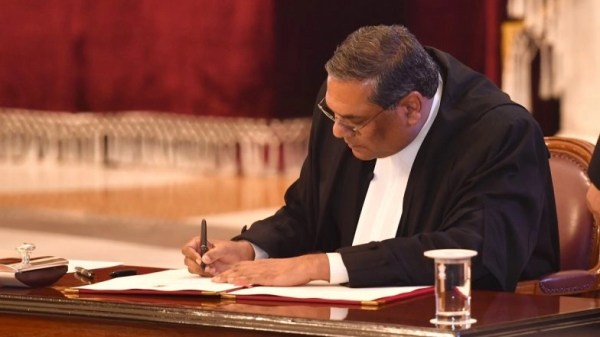
The Judiciary is frequently criticised for keeping judicial appointments an opaque affair. However, the process is facing a silent crisis of executive delay. Recently, the Supreme Court released a list of candidates who were recommended by the Supreme Court Collegium, but were not appointed as High Court Judges by the Ministry of Law and Justice since 2022. This systemic issue was further underscored by research conducted by the Supreme Court Observer, which found that the Central Government did not accept 24% of all recommendations by Justice Sanjiv Khannaโ€™s Collegium. This piece aims to argue that this unnecessary practice of the Central Government not only exacerbates the predicament of vacancies in the High Courts, but also constitutes a grave violation of the principle of Separation of Powers.

In conversation with Swapnil Tripathi

In this interview conducted by CLS, we talk to Swapnil Tripathi.Swapnil is the Lead at Charkha (Centre for Constitutional Law) at Vidhi. His areas of specialisation are judicial review and constitutional interpretation, with a particular focus on Public Interest Litigation. He is also an Associate Fellow of the Royal Commonwealth Society, nominated in recognition of his work in the United Kingdom.

โ€˜Hard Look Reviewโ€™ and Data Privacy โ€“ Providing an alternative to the Proportionality Test

Proportionality test has been used quite often in Indian constitutional law jurisprudence. In the absence of a clearly defined rule or standard, courts resort to proportionality standards, that is, balancing individual interests against broader public or state interests. This article will argue that while proportionality has been the dominant lens through which courts evaluate data privacy infringements, procedural doctrines like the hard look review can serve as a complement to proportionality tests.

Lost in Translation: The Constitutional Case Against Hindi Imposition

In recent years, the Union Governmentโ€™s push for Hindi in governance and education, particularly through the National Education Policy, has triggered constitutional concerns. Though framed as promoting multilingualism, the policy's implementation effectively coerces non-Hindi speakers, especially in Tamil Nadu, into linguistic assimilation. This article argues that such imposition violates fundamental rights and fails the proportionality test outlined in Puttaswamy, undermining Indiaโ€™s federal structure and commitment to linguistic diversity.

70 Years of Ram Jawaya Kapur:ย Analysing the Diminishing Influence of Indian Legislature in Contrast with โ€˜Executive Aggrandizementโ€™ in Constitutional Governance

This article critically examines India's diluted separation of powers, stemming from the *Ram Jawaya Kapur* (1955) ruling that favored executive efficiency over strict separation. It argues that this model, particularly with majority and coalition governments, leads to legislative undermining through mechanisms like bypassing parliamentary scrutiny (guillotine, reduced committee referrals). The article concludes by advocating for strengthening legislative oversight mechanisms to counter this "silent shift" towards executive aggrandizement.

Adolescent Relationships and the Indian Legal Framework: Urgent Need for Reform

The Indian legal framework governing adolescent relationships presents a fundamental conflict between child protection and individual autonomy. The Protection of Children from Sexual Offences Act (POCSO), 2012, and Section 375 of the Indian Penal Code (IPC), 1860, criminalize all sexual activities involving minors under 18, disregarding adolescent agency and the evolving understanding of consent. This rigid approach undermines constitutional rights, particularly the right to privacy under Article 21 and the right to equality under Article 14. Judicial interventions have attempted to mitigate the lawโ€™s harsh consequences by distinguishing between exploitative and consensual relationships, yet legislative inconsistencies persist. Comparative legal analyses reveal that several countries incorporate close-in-age exemptions and focus on restorative justice rather than strict penalization. Indian law must align with these global best practices by recognizing adolescent psychological development and implementing legal reforms that differentiate between exploitation and mutual consent. This article advocates for statutory amendments that introduce close-in-age exemptions, promote non-punitive interventions, and ensure gender-neutrality in legal provisions. A nuanced and balanced legal framework will protect minors from harm while upholding their dignity and autonomy, thereby fostering a more just and equitable legal system.

Up ↑