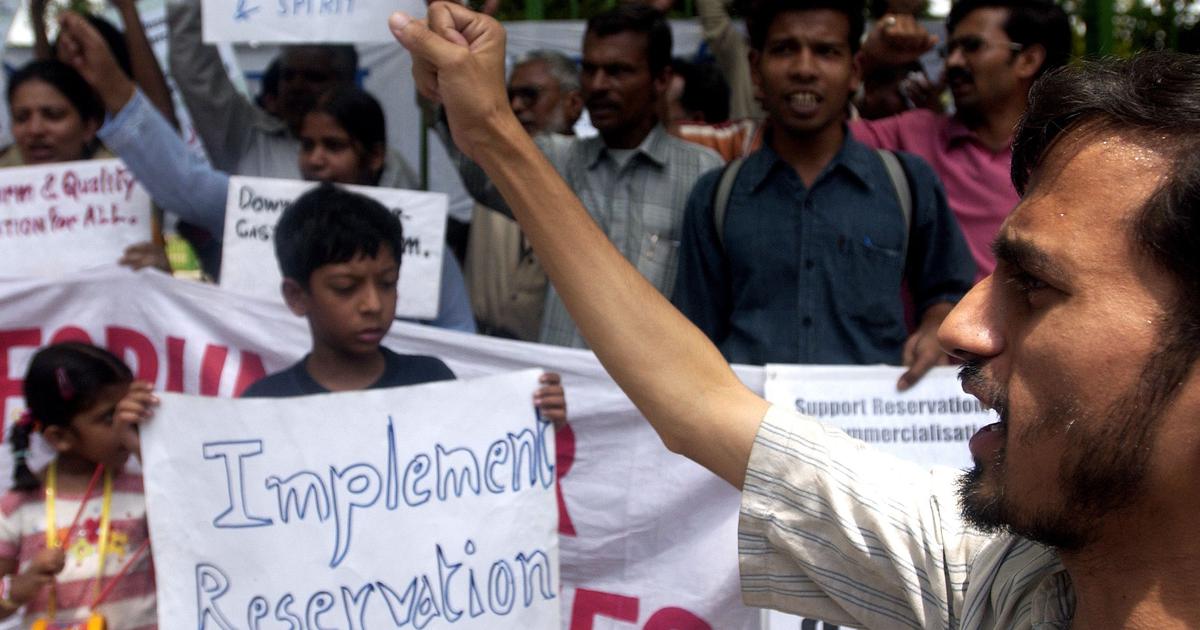
Nearly eight years back, the Hon’ble Supreme Court in Bir Singh v. Delhi Jal Board settled a contentious issue on extending scheduled caste (“SC”) and scheduled tribes (“ST”) reservation benefits to citizens to inter-state and inter-union territory migrants. Answering in the negative, the court reasoned that Article 341’s wording mandated territorial restriction of such benefits in relation to the state alone. Ever since, this has been the prevailing practise in India’s regime of affirmative action, with absolutely no leeway, let alone a shift from the ratio in Bir Singh.
The status quo of India’s SC Reservation Regime is such that a person belonging to a caste notified as a Scheduled Caste in State ‘A’ cannot claim the same status in another State on the basis that he is declared as a Scheduled Caste in their state of origin. While the validity of this practice has been questioned in multiple cases, the courts in Bir Singh v. Delhi Jal Board, Subhash Chandra v. Delhi Subordinate Services Selection Board, and Marri Chandra Shekhar Rao v. Dean have consistently provided two main reasons for their decision: (a) identical caste nomenclature across two states does not automatically imply identical caste-based discrimination and (b) Article 341 explicitly requires reservations to be notified in relation of that state.
With this arises a paradox: what about those individuals who have suffered caste-based discrimination through their formative years but are subsequently denied reservation benefits on the grounds that the state they’ve migrated to does not enlist their caste in its SC List? This becomes sufficiently important while statistics reflect that 40% of work-related migrants came from a different state. Existing literature on reservation benefits for inter-state migrants has outlined the gravity of this practice. Consistent arguments have remained that the prevailing practise violates Articles 14 and 16 since it classifies citizens in the SC/ST community without a rational nexus.
In my article, I do not intend to rehearse those arguments, but instead, I wish to highlight a concern that is less viable but equally impactful.
I seek to first, explain the shortcomings of the state specificity doctrine, secondly, argue that the extant reservation model falls short of its core substantive mandates, thirdly, establish that the bar created by Article 341 has been misread to restrict reservation benefits, and lastly, to propose a justifiable state that balances both sides in the ‘reservation rights for SC migrants’ debate.
Addressing the State-Specificity Doctrine
Since the decision in Action Committee on Issue of Caste Certificates to SC/ST in Maharashtra v. UoI, the courts have maintained a consistent reasoning for the state-specificity doctrine applied to implement the SC reservation scheme, that even identical nomenclature of two castes does not imply similar social status is well-founded.
The prevailing mechanism of providing state-wise reservations for the members of the SC community may seem to fulfil the states’ guarantee to help in uplifting disadvantaged sections of society. However, there exists the problem that historic discrimination is portable. The cumulation of the oppression manifested in inter-generational setbacks in educational, financial as well as social set-ups does not cease to exist at state borders. A migrating individual carries the historic and systemic deprivations of their ancestry, regardless of their caste status in the new state. Thereby, even if the new state may not be oppressive to the incoming migrants, the effects of being structurally disadvantaged continue to prevail.
When the prevailing mechanism removes an SC individual from the reservations scheme merely upon migration to a non-recognising state, it fails to account for the cumulative disadvantage that the individual and their ancestry would have suffered until that act of migration. The systemic oppression in the state of origin is likely to have resulted in a substantial deficit of skillsets, and this creates a fundamentally unequal starting point compared to the ‘General’ category peers in the new states. Consequently, the absence of contemporary discrimination does not negate this inherited structural inequality; state support is therefore justified as a necessary measure of compensatory justice to mitigate the long-term effects of antecedent deprivation and facilitate the attainment of substantive equality by effectively “levelling the playing field” that remains inherently uneven.
Historic Failure of Constitutionality
Caste-based reservations are unique to India and stem from centuries-long discriminatory practices meted out to people belonging to certain communities – here, the SCs. Reservation policies for the SCs, such as reserved seats in government-run educational institutions, public service commissions, et cetera, stem from historic discrimination, i.e., restricted access to public facilities, education, and health care. Provision of these schemes is justified on two grounds: (a)as reparation for the discriminatory treatment vetted out to the community, and (b) to enhance the representation of the SC community in employment, educational institutions etc.
Thereby, while historical marginalization and systemic deprivation of the SC Community have inevitably culminated in their underrepresentation in formal employment, educational institutions etc, the rationale for reservations extends beyond the objective of corrective representation. As emphasised in the Mandal Commission Report, reservations must also be understood as a reparative mechanism, intended to address the structural injustices and cumulative harms inflicted upon these communities over centuries.
In this sense, affirmative action is not merely instrumental in fostering inclusivity in contemporary institutions but is simultaneously a moral and constitutional acknowledgment of historical wrongs, functioning as a form of restorative justice.
Now, considering the existing drawbacks in parallel with the two objectives of India’s reservation regime, denying reservation to migrated SC members deprives them of both: due reparations, as well as the necessary push to equalise representation. Thus, state-wise reservations fail the principle behind the affirmative action system in India.
Addressing the Requirements of Article 341
Article 341(1) of the Constitution reads as follows:
“The President may with respect to any State or Union territory, and where it is a State after consultation with the Governor thereof, by public notification, specify the castes, races or tribes or parts of or group within castes, races or tribes which shall for the purposes of this Constitution be deemed to be Scheduled Castes in relation to that State or Union territory, as the case may be.”
To begin with, the courts have specifically sought to apply the expression ‘in relation to that state’ to restrict the extension of SC/ST reservation benefits beyond the territory of the specific state. Beginning from Marri Chandra Shekar Rao v. Dean, Seth G.S. Medical College, the SC has repeatedly observed that the expression “in relation to that state” would become nugatory if the SC benefits were extended throughout the territory of India. To this extent, I submit that there exists a fine line of difference between being deemed an SC/ST and receiving benefits provided to said community.
The application of Article 341 is restricted to the identification of certain communities as SC, however, the power to provide reservation benefits to these communities is derived from Article 16. Thus, I submit the need for a harmonious construction of Article 341 and 16, positing a structural bifurcation between the identification of status and the administration of affirmative action. This would imply that Article 341 serves as a mechanism limited to identifying specific castes as SC in relation to the socio-cultural prejudices of a specific state, while Article 16 serves as a broad, substantive mandate for the state to ensure equitable benefits to the discriminated community.
By decoupling ‘geographical origin’ of discrimination from the ‘portability’ of the resulting legal status, the determination of SC status remains state-specific as required under Article 341 while the reservation benefits afforded to such status become an inherent attribute of the individual across the national territory. However, an unchecked extension of reservation benefits will negatively impact the rights of the local SC community of the state. Thus, I propose a shift from the existing mandate to a justifiable state in affirmative action.
Call for a Justifiable State in Affirmative Action
The process of ensuring that reservation benefits reach those who truly need it is a strenuous process riddled with problems. Often, the attempt to solve one problem gives rise to another. This is a similar situation, where the court’s attempt at creating an equitable framework resulted in the prejudice of another section, the migrant SC community. Thereby, I propose a justifiable state where we can simultaneously balance the need to include migrating SC individuals, but ensure reservation benefits are used only in the benefit of those who have been directly or indirectly victims of caste-based oppression.
Inspiration for this is drawn from the framework followed in a parallel reservation plan – the domicile reservations. Domicile reservations in India are provided to those individuals who have obtained a domicile certificate by proving long-term residence in the state. For this purpose, birth in the state is neither a prerequisite nor a guarantee of domicile status. Likewise, I propose a domicile-based caste certificate. Here, individuals will be given the SC-status certificate if the state they have been domiciled in, notwithstanding their place of origin, treated their caste in a discriminatory manner, such that it has been notified in the SC List of the domicile state. This can be implemented in a two-tier manner:
Tier I (Origin State): Full constitutional benefits (e.g., job reservations, education reservations, etc) are permanently reserved for individuals in their State of Origin, acknowledging the localised nature of oppressive treatment.
Tier II (Domicile State): Migrated SC members who establish domicile may be eligible for a limited, non-quota-based set of benefits provided by the new state, such as tuition waivers, interest-free loans, etc. This allows restorative justice without directly displacing the reserved quota seats intended for the local SC population. Even if the benefits were extended in the form of direct reservations, it should be done through a restricted Sub-Quota exclusively for domiciled SC Migrants. This will ensure that they do not face loggerheads with the state’s indigenous SC population for the primary reserved seats.
Conclusion
Thus, the existing regime for positive discrimination in India inadvertently fails to shield a significant portion of those who are in dire need of these benefits – the migrant SC community. To this extent, the subtle shift from benefits based on origin state to benefits based on domicile state, enforced with due exercise of intelligible differentia, will effectively ensure that the migrant SC individual is simultaneously provided benefits while safeguarding the rights of the local SC community.
The author is a third year student of the Rajiv Gandhi National University of Law, Punjab.
Image Credits: Press Trust of India


Leave a Reply