Ethnic Cleansing: A Prosthetic for Genocide?
Ethnic cleansing is a relatively modern term; a creative brainchild of the imaginations inspired by the Bosnian genocide. The word ‘ethnic cleansing’ is derived from the Croato- Serbian term: ‘etnicko ciscenje’, as a military usage in the Serbian army. The English translation to ‘ethnic cleansing’ was subsequently made by the Western media. The ICJ judgement on Bosnia v. Serbia discussed the legal implications of ethnic cleansing based upon its interpretation in the report by the UN Commission of Experts (¶190). Ethnic cleansing is defined as the process of making an area ethnically homogenous by removing dissimilar groups either by ‘force or intimidation’ (¶129).The ICJ comments that ethnic cleansing by itself does not constitute the crime of genocide as per the Genocide Convention. The prestigious court furthers this pedantic interpretation by adding on that the proposal to include “measures intended to oblige members of a group to abandon their homes in order to escape the threat of subsequent ill-treatment”was rejected while drafting the Genocide Convention (¶190).
The global community considers genocide as the gravest of crimes. The International Criminal Tribunal for Rwanda (ICTR) exceptionalised genocide by calling it the ‘crime of crimes’;the decorated notoriety of such titles often obfuscates the fact that the punishment for genocide does not supersede the sanctions for other international crimes in proportion to its etymological intimidation. It seems that it is a habit of Justice to create rigid exclusivities for heinous crimes. This habit causes a rigid exclusivity to the punishment of such crimes as well. To draw a parallel, the Indian judiciary saves the death sentence for the most heinous of crimes, in the ‘rarest of the rare cases’. Similarly in many cases of alleged genocide, the international courts hold their breath over intensely scrupulous scrutiny of the facts of each case; and exhale at a hint that suggests that the allegations may not duplicate the strict definition of the crime. The Darfur Commission report recognised patterns of ethnic cleansing; yet decided that the Government of Sudan should not carry the blame of being a perpetrator of genocide.
Genocide is (strictly) defined by the Convention as ‘acts committed with intent to destroy, in whole or in part, a national, ethnical, racial or religious group’. The special “intent” also referred to as ‘dolus specialis’, is what sets Genocide apart from other international crimes. Supposedly ethnic cleansing is perceived to be a weaker crime; almost a pseudo- innocent justification that Respondents make to absolve themselves of liability. In this way, ethnic cleansing becomes an obscured prosthetic for the genocidal crimes; a self- contradictory excuse.
The Human Nature to Ethnically Cleanse: making a geographical area ethnically homogenous
It is naturally common to have territorially possessive instincts. From the wild to wealth, humans have consistently exhibited weariness for other cultures or ethnicities.Uniformity brings comfort, efficiency and reduces complications. Upon transitioning from hunter- gatherer lifestyle to the agricultural one, man acknowledged the power of consistency. What once used to be an era of humans acting according to nature then transitioned to a period of man manipulated the surroundings. Clearing out forests to cultivate only one kind of crop, domesticating animals to keep the rest at bay; one may wonder if ethnic cleansing is an intrinsically coded human trait. Commonality is comfort. From the religious marginalisation in ancient India to the current ethnic wars, the desire to alienate and ostracise difference has overwhelmingly affected all aspects of our development. In its nomenclature itself, ‘ethnic cleansing´ is completely actor- motivated and negligent of the victim- suffering. To remove the alien communities is to cleanse the desired territory, making it devoid of impurities and unwanted dissimilarities. If not the physical removal of the alien ethnicities, States tend to oppress the culture of foreign entities; robbing them of their nativity to eliminate differences. This narcissism is often instigated by the fear of the unknown; causing exceeding comfort for the known. This exceeding comfort, like cancerous cells, eventually extrapolates to a sense of superiority. This reflects Dietrich Bonhoeffer’s theory which says that, ‘for the Power of one, there must be stupidity of the other’.
Thus, ethnic cleansing is unfortunately often a psychological defence strategy rather than a prima facie offence.
That brings us to the next question:
Ethnic Cleansing: Tyranny or Tool?
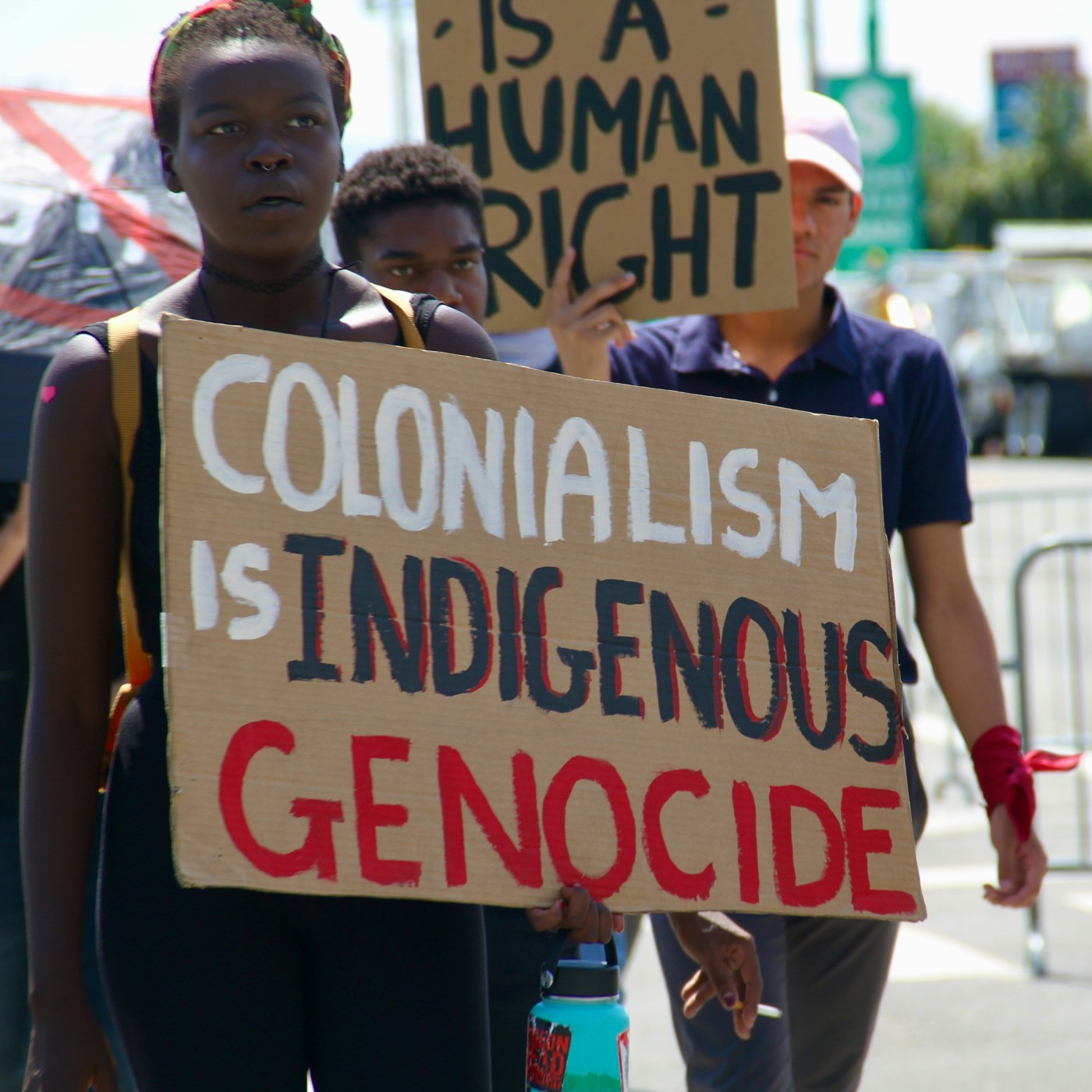
Rigid immigration policies are not vastly different from ethnic cleansing. The psychological defence strategy often materialises into violence, driven by the urgent need to bring about clean and physical classification. The ethnic cleansing then becomes genocide; when the process of making a territory ethnically homogenous translates into the complete or in- part deliberate annihilation a group of people. The holocaust is a repeatedly referred attempt at social classification made into a megalomaniacal attempt at erasure of a race. Many judicially recognised genocides, such as the Bosnian war and the Rwandan genocide, are now condemned by the global sentiments. Yet, the historic expulsion of the Native Americans is one of the more concealed crimes of history. Thomas Jefferson’s systematic land acquisition policies to drive out the Indians were considered as shrewd development strategies for the betterment of America. Thomas Jefferson was a politically benevolent speaker. His image was popularised by a rhetoric that he was almost sympathetic to the native Americans, his repeated contention being that agriculture was the primary missing link that divided the Indians from development. Alienating them meant that the civilised European Americans could utilise the extra land to catapult their progress into being a developed country, the Indian Removal Act being a statutory proof. The current international scenario witnesses terrible aggression between different ethnicities; whether it be Israel- Palestine or the violent subjugation in Sudan by the gendarmerie. The tyranny of ethnic cleansing stirs philanthropic activation across the countries.
However, as mentioned earlier, ethnic cleansing as a term and an action is provides negligent acknowledgement for the victims. Ethnic cleansing is thus often disguised as a tool for political leverage; based upon borderline manipulation of the dominant group that the targeted victims are unnecessary burdens. Indian immigration policies in Assam have often been employed as a tool disguising ethnic cleansing to garner votes and political popularity.
The juxtaposition of perception of whether ethnic cleansing is a tyranny or a tool reveals the very flaw of apathy facilitated by the liberty of democracy.
Who dare claim the land?
Immigration policies and immigrant policies are both devices in which ethnic cleansing plays hide and seek. With several countries adopting the anti- immigration stance, one would wonder what happens to the constitutional rights of the immigrants. Is there no law without land? Why do some have more rights to land than the others? A baby of Indian parents born in a foreign state has superior right to claim India than a baby of an immigrant born on the Indian soil. The latter may be more acclimatised to the land; yet must bear the brunt of inferior consideration.
A plethora of reasons makes the host country weary of the influx of immigrants. Economical rearrangement, revenue management, employment scope, xenophobia, etc. are some to be named. The indignation of the host country upon conflicts on any of this topic is based on an arguably absurd conception of a higher right to the land.
History is defined by displacements: intentional and not. The homo sapiens travelled from Africa to the Americas. Must we now assume that they had dual citizenship of Eastern Africa and the Amazons? Which land could they claim with more assuredness, and who could they win the race of claim over?
In India, the advent of Aryans displaced the native inhabitants, the Dravidians, to the south; according to Max Muller’s popular theory of Aryan- invasion. During the era of kings and kingdoms, regular annexations were commonly followed by settler colonisations. Mongols from Central Asia established one of the greatest empires in India, and introduced a stable Muslim diaspora. The current political rhetoric is often driven by the undertones of religious conflicts in India, with many accusations and counter- accusations of prioritising the dominant religion. But who dare claim the land of India? If the historic foreign settlements within the country is the buttress to the argument of the ‘original land owner’, how far into the past must we go in search of irrefutable validation of ownership? What draws the line between conviction and absurdity?
The Indo- Pak partition in 1947 followed by the Bangladesh- Pakistan partition in 1971 caused considerable displacement and reorganisation; of course, coupled with the interpretative ethnic cleansing. The chaos of ethnic segregation paved way to one of history’s most notorious debacles; the effect of which is still persistently troubling peace. The subsequent immigration policies are contaminated with prejudiced politics. In a way most rigid immigrant policies are a form of legally permissible ethnic cleansing. Does this contradiction arise out of the faulty definition of ethnic cleansing or the faulty character of law?
A Loophole in Law
Why is ethnic cleansing not defined explicitly in law? There may be multiple reasons for the same. It is a relatively modern definition, employed to describe the crimes rather than define them. Ethnic cleansing is still very ambiguously termed and can be utilised to describe multiple themes, from crimes closely mimicking genocide to even constitutionally permitted schemes. The law makers may be apprehensive that completely criminalising ethnic cleansing would rob the political power- houses of their right to be confident in their exclusive ownership of their land. When ethnic cleansing becomes violent, the means of achieving the same are punishable by international law, but not the act itself. This lacuna in law often enables the expulsion of unwanted ethnicities. When justice turns a blind eye, where do the victims go?
The Indian Constitution guarantees equality before law to all persons residing in India, regardless of their caste, creed, gender, race and place of birth. The seven- judge bench notably commented in the judgement of Maneka Gandhi v. the Union of India, that a holy trinity exists between Articles 14, 19 and 21 of the Indian constitution. Right to equality, right to freedom of expression and right to life, essentially are safeguards against the very concept of ethnic cleansing. As mentioned previously, attachment to land is an important factor motivating ethnic cleansing. Right to property was removed as a Fundamental Right by the 44th amendment. Many prominent thinkers have discussed and debated the importance of recognising right to property as a non- negotiable right. Emmanuel Kant was of the opinion that the entire structure of law would crumble if the recognition of right to property as fundamental, was taken away. Some on the other hand, believed that while extra- personal rights must be safeguarded, right to property cannot be fundamental. The subsistence of the feudal systems would hinder India’s socio- economic progress; and the right to property if considered sacrosanct, would inhibit holistic development in a socialist State. Thus, the right to property is no longer considered as fundamental right.
Within borders, the States are almost entitled to carry out the process of ethnic cleansing. Beyond, borders however, ethnocides fall under quick scrutiny of the global eyes, that try to determine the veracity of the justification for such trans-boundary hostility. Prejudice however is a cunning trickster that renders one blindfolded in the visage of reality.
Tryst of Land and Man
This brief discussion of the Right to Property was found to be relevant to assimilate how the judiciary considers the importance of the nexus between man and land. The comprehension that possession of land cannot be permanent opens several avenues of thought relating to ethnic cleansing. An area of land is static, whereas the humans are defined by their dynamics. Ethnic cleansing within and beyond borders, is hence a concept that again incorporates the constitutional boundaries, prioritising sovereignty; and complete sovereignty can only be guaranteed when there are well defined boundaries. This desire that humans harbour for possession of land is deemed superficial when the adjustments serve the necessity of development and reform, and is at the same time considered as a revered relation; when it comes to denying an “alien” to the enjoyment of the same land. The same right that can be brushed away to sow the seeds of socio- economic reforms is also used as a justification for rendering millions of people homeless.
The Citizenship Amendment Act of 2019, furthers the concealed ethnic cleansing via its non- secular provisions of excluding Afghanistani and Pakistani Muslims from claiming Indian citizenship; a lawful enabler of ethnic cleansing. Similarly, 1.9 million residents were rendered homeless after their name was excluded from the National Register of Citizens in a (successful) attempt at implementing the immigration policies. The implementation of the same was widely celebrated by the then ruling party; satisfied in their achievement of gaining a lucrative vote- bank for the next elections. Thus the tyranny of the act is obscured by the utility of the tool it can be employed as.
Boundaries and Ethnic Cleansing
Ethnic cleansing within the boundaries is logically, the more common practice. By definition, if one has a desire to make a geographical area ethnically homogenous, he or she must be a stakeholder of the progress of the land. Ethnic cleansing targeting areas beyond the boundaries are almost always an act of genocide or active authoritative suppression. This essay has delved upon the concept of land’s connection to ethnic cleansing; and it is concluded that territorial possessiveness is the more common factor that instigates ethnic cleansing rather than outright villainous hegemony gaining dominance through annihilation. The latter is however not uncommon; as the current world affairs are a clear testimony.
Ethnic cleansing, whether veiled in policies or unleashed through violence, reveals the flawed intersection of law, politics, and human nature. As history demonstrates, the ambition for territorial purity persists in legislative frameworks and international crises, often cloaked in claims of national security or progress.
Ultimately, this essay contends that consistent peace and constitutional justice require confronting this legacy of exclusion with unwavering commitment to rights and equality to one and all. Only by recognizing the suffering and displacement wrought by these policies can societies and nations attempt to build boundaries that respect difference, rather than perpetuate cycles of oppression.
The author is a second year student of the West Bengal National University of Juridical Sciences.
Image Credits: Manny Becerra


Leave a Reply