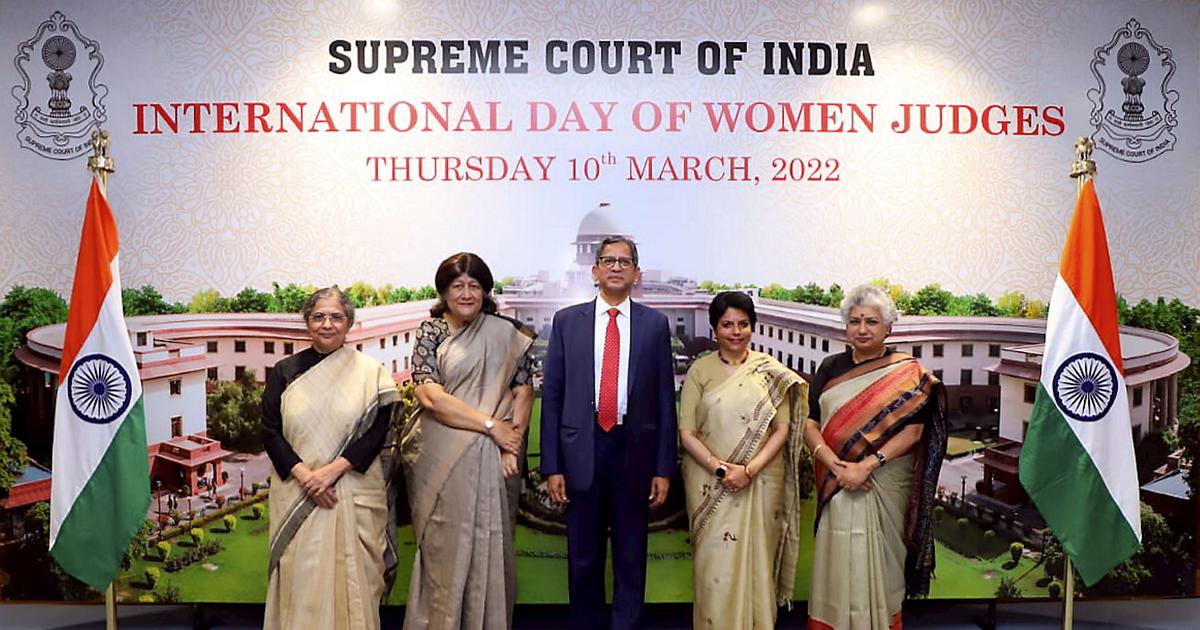
When one thinks of Justice B.V. Nagarathna, one notices how irony is personified in India’s justice system. The nation’s highest arbiter of constitutional morality, the Supreme Court, which interprets fundamental rights for the entire nation, remains remarkably unreceptive to feminism within its own walls. The institution vested with the power to judge whether a task is fair, reasonable and free from bias, itself retreats into a profoundly biased discourse of stereotypical limitations and “market realities of women”.
This blog examines the Indian judiciary’s fraught relationship with gender justice by recognizing the institution not only as a dispenser of justice but also as an administrative body in itself. It argues how the Collegium’s appointment decisions guided by undeclared factors like suitability and merit, are frequently gendered in reality.
Statistical Landscape of Exclusion
As per the Ministry of Law and Justice, while the Government is committed to improving diversity in judicial appointments, only those persons actually recommended by the Supreme Court Collegium are appointed as Judges in the Supreme and High Courts. As of February 2026, Justice Nagarathna stands as the only female judge in a sanctioned bench of 34. Out of a working strength of 781 judges in the High Court, only 115, or approximately 15% of them are women. Three High Courts, i.e. those of Uttarakhand, Manipur and Tripura have no women judges even for namesake representation.
This ‘funneling out’ of women is not merely a statistic of neglect but a deliberate outcome of an active administrative process by the Collegium. The government’s response by stating that appointment of judges under Articles 124, 217 and 224 of the Constitution does not provide for ‘reservation for any caste or class of persons’ effectively indicates the absence of influence or control that the government has upon the Collegium system. The Collegium’s appointment power operates on high discretion, minimal transparency, no demographic guidelines, and most importantly, no judicial review of its own appointment decisions.
During the tenure of CJI D.Y. Chandrachud and Sanjiv Khanna, a new expectation of accountability was created by recording the reasons for rejecting names, referencing Intelligence Bureau reports and explaining selection parameters. However, during the tenure of B.R. Gavai as the CJI, the Collegium seems to have reverted to its old ways with the elevation of Justice Pancholi, despite the availability of three senior women judges for selection. His elevation offered no justification and showed the Collegium’s retreat into opacity.
According to Prof. Upendra Baxi, the social meaning of rule of law demands that power must always be rendered accountable, governance be made progressively just and the state should become incrementally ethical. However, the Collegium’s power doesn’t seem to uphold this standard. Administrative functions exercising discretion are subject to the risk of abuse if they are exercised without procedural fairness and reasonableness, for mala fide purposes, for improper motives, etc. In E.P. Royappa v. State of Tamil Nadu (1974), the Supreme Court itself had established that arbitrariness is antithetical to equality, which applies stingingly to its own appointment practices.
The Menstrual Leave Judgment: Paternalism in a Robe
This discourse on gender sensitization in the judiciary was recently highlighted in two seemingly contradictory decisions of the apex court. In the case of Shailendra Mani Tripathi v. Union of India (2023 SCC OnLine SC 228), while the apex court dismissed the PIL directing the government to consider a model policy, the oral remarks made during the hearing gave a view of the ‘administrative gaze’ of these harbingers of justice. The CJI went on to remark that menstruation was not a genuine biological hindrance but rather the PIL puts an impression on women that they are not on par with male persons to work as they still have ‘natural issues’ during particular times. The Bench elaborated that if menstrual leave is made compulsory by law, it would declare them as an unattractive human resource, damaging their careers and that even in judicial services, trials won’t be assigned to women.
To flag that employers will not assign responsibilities to women if right to menstrual leave is mandated assumes that workplace structures are immutable and women must adapt rather than the structures be modified to accommodate. It internalizes the very discrimination as a natural and inevitable reason to deny rights that anti-discrimination law seeks to challenge. The rule of proportionality requires the decision maker to favour the less drastic means to achieve a legitimate end. Women’s employment could be protected by strengthening action against discrimination rather than preemptively surrendering women’s health rights to these employers.
Based on the doctrine of irrelevant considerations, an administrative act is void if not based on relevant considerations i.e., there is no reasonable connection between the facts and the grounds, and the decision is based on personal feelings of the maker. Since the Court prioritized the business/profit-focused model of the private sector over the fundamental right to health and dignity, it permitted an improper purpose to influence its discretion. Critically, the Court’s claim that a female judge won’t be assigned a normal trial inadvertently gives judicial legitimacy to the very mindset of employers it was warning against, making it a classic case of judicial stereotyping. This warning itself becomes the bias.
The Supreme Court in its own Handbook on Combating Gender Stereotypes had warned that having preconceptions of women’s ‘inherent characteristics’ or biological limitations skews the application of law; as instead of an objective evaluation of the situation, it goes against the principle of ‘equal protection of laws’ by perpetuating stereotypes. The concept of Wednesbury unreasonableness states that an administrative action is invalid if it is one that no reasonable body could have arrived at. If this applies to the justice’s “normal trial” comment, it could be argued that the assumption of incapacity is irrational as there is no empirical proof to suggest that female judges are less efficient or capable of presiding over trials due to menstruation.
The Bar Council Reservation Paradox
While the Supreme Court voiced deep stereotypical concerns above, it had championed reservation in professional bodies in Yogamaya M. G. v. Union of India and Ors, representing a genuinely progressive order. Through its sweeping plenary powers under Article 142, the Court deemed to have made the mandate that ruled that the BCI must interpret its existing rules to ensure that 30% seats in each State Bar Council are occupied by women members. For the 2025-26 election cycle, 20% of the reserved seats were to be filled via women’s elections and the rest 10% via co-option if the number of women seemed inadequate. Given that women’s representation in the State Bars were abysmally low at 2.04%, the decision enforces affirmative action in professional, non-elected bodies by interpreting the Advocates Act, 1961 to enable structural entry to women, countering barriers like politicization and high campaign costs.
Usually demands for judicial diversity have invoked excuses like the so-called ‘leaking pipeline’. Since women leave legal practice mid-career due to inadequate institutional support, caregiving burdens, marriage, patriarchy and other systemic biases, it limits the pool available for appointments to the higher judiciary. While this is factually correct, it fails to take into account that the pipeline leaks because the judiciary is designed around the model of a ‘male unencumbered worker’ who has no caregiving responsibilities and fails to accommodate the realities of women’s lives. When the administrative powers of the judiciary fail to provide an empathetic institutional design such as creches, safe-retiring rooms and gender sensitive infrastructure, it fetters its own discretion by excluding a vast talent pool and establishing systemic bias, hence preventing them from actually considering each case on merits.
In the Yogmaya judgment, the Court indirectly acknowledged that structural intervention was necessary to correct exclusion as waiting for the ‘pipeline’ to naturally progress to deliver equality is not a sufficient approach. If structural under-representation in the Bar is such a constitutional concern that the Court had to deem rules amended for the Bar, then it raises an internal contradiction of why the same logic is resisted for judicial appointments.
Extending the Logic from Bar Councils to Benches
The presence of women in the judiciary is vital to its legitimacy because citizens are not likely to accept judiciary as a harbinger of human rights and justice if the judges themselves are said to act in a discriminatory manner.
The rationale in the Yogmaya judgment showed that mere participation or presence of women in the legal profession did not translate into representation. The judiciary operates on convenience and not on principle if it reserves 30% of the Bar’s seats for women while leaving its own benches almost fully male-dominated. If Articles 124 and 217 don’t provide for reservations, they also don’t prohibit it. It only establishes the qualifications and procedure of appointment, while the rest is left to what is decided under the Memorandum of Procedure and practice of the Collegium.
Further, at least 38% of the subordinate judiciary is occupied by women. The Supreme Court Bar Association President remarked that this was because unlike the Supreme Court and High Courts, there, the selection was based on merit and competitive examinations. This shows that while merit and representation could actually co-exist, the pipeline leaks when the collegium treats gender diversity as an afterthought rather than non-negotiable constitutional value.
The assumption and contention that merit and diversity are oppositional are worthy of scrutiny. Merit would simply encode the existing privilege if it were defined and developed by institutions that historically excluded women. The problem isn’t whether to consider merit or not, but whether the interpretation of merit adequately captures the female realities and qualities necessary for judgment in a diverse society.
In 2025, the then CJI B.R. Gavai commented that even if diversity is a strength of tribunals, members from administrative backgrounds are generally averse to passing orders which are against the government and hence require training in legal reasoning to increase their effectiveness. If training is used to correct bias against the government, a similar approach could be adopted to address gender sensitization among judicial members to eliminate inherent bias against women.
Conclusion
The inclusion of women in the judiciary is not merely about representation but also about integrating varied gender perspectives into the system so that they have equal voice and visibility in contributing to a nuanced and comprehensive legal system and societal change. For the judiciary to be truly feminist, it must apply the social meaning of rule of law starting with its own Collegium. The Collegium should provide decisions which are reasoned on the selection of ‘suitable’ candidates and issue transparent criteria of merit for appointments.
The judiciary must be inclusive to account for the diverse experiences of women across class, caste and disability as otherwise if feminism only benefits the upper-caste women having high social and economic capital, it will be a failure of the equality code under Article 14. Further, it must be necessitated that the benches reflect the population it serves. It is the appearance of impartiality and not just the absence of demonstrable prejudice that serves the rule against bias.
Justice B.V. Nagarathna is to become India’s first woman Chief Justice of India in September 2027, however with a tenure of a meagre 36 days for a court that is operating for 77 years. This number does not represent a milestone, but a measure of how far the justice system still has to go. Until the judiciary can implement the principle of dignity and equality on itself, its declarations about gender justice, even if strong rhetorically, remain distorted by the institutions in which they are produced.
The author is a third year student of the Chanakya National Law University, Patna.
Image Credits: Press Trust of India


Leave a Reply